FurniSquare's wooden shoe racks are entryway storage for footwear, and the pieces here come in a few forms: closed cabinets, open shelves and benches with a cushioned seat. Our living room furniture page covers the rest of the room, and the sections below explain how to choose between these pieces.
Choosing Wooden Shoe Storage for an Entryway
Start with how you use the door. For shoes out of sight, choose a closed cabinet. For quick access, an open shelf suits better. For somewhere to sit while putting on shoes, choose a design with a seat.
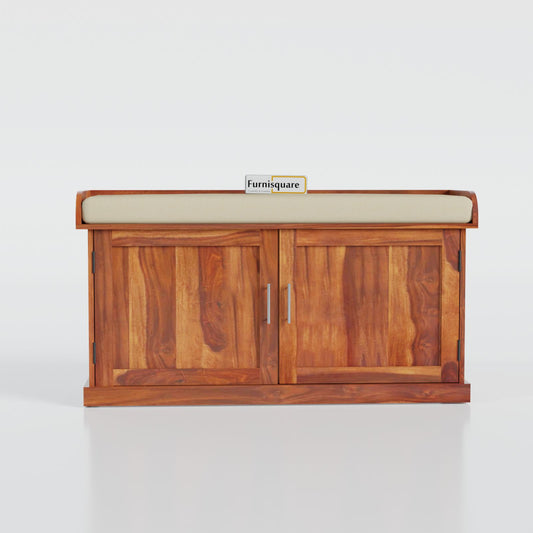
The current pieces show the options. One is a low cabinet with a cushioned top, two doors and an inner shelf, offered in Walnut and Natural finishes. Another is described as a cabinet-and-bench set: a tall two-door cabinet with shelves inside, paired with a low unit with a closed front. The third is a bench with a cushioned seat, a slatted closed section on one side and an open shelf on the other. All three list solid Sheesham wood in their specifications, and each product page gives the full details.
Open and Closed Storage, Including Seating
Closed storage keeps shoes out of sight, which helps when the entryway opens into a living area. Open shelving gives quick access and shows what you have. A seat gives you a place to sit, but a seated piece needs more depth than a plain rack, so check that it leaves room to walk past. The product pages do not list how many pairs each piece holds, so count the shoes you want to store and compare that with the space inside, as shown in the photos.
Dimensions and Measuring the Available Space
The cushioned cabinet is 105 cm wide, 35 cm deep and 60 cm high. The cushioned bench is about 119 cm wide, 40 cm deep and 49 cm high. In the cabinet-and-bench set, the tall cabinet is about 51 cm wide, 40 cm deep and 186 cm high, and the low unit is about 102 cm wide and 51 cm high.
Measure the space along the wall and the clear floor in front, and allow for doors to swing, pull-out sections to open and a clear path past the piece. The listed dimensions describe the outside of each piece. If you need space for bulky shoes or boxes, confirm the internal clearance before ordering.
FAQs
What is the difference between a shoe rack, a shoe cabinet and a shoe rack with a seat?
A shoe rack is the general name for shoe storage, often with open shelves. A shoe cabinet has doors that keep shoes out of sight. A shoe rack with a seat adds a top you can sit on. Many pieces combine these, so judge each by its storage, front and top.
Should I choose open or closed shoe storage?
Choose open shelves if you want to see and reach pairs quickly, and closed doors if you want shoes out of sight. A mix works too: the current pieces include a closed cabinet, a closed section beside an open shelf, and a tall cabinet paired with a low closed unit.
What should I consider when choosing a shoe rack with a seat?
Check the depth, because a seat needs more room than a plain rack, and leave space for doors to open or sections to pull out. Look at the height of the top for sitting. If you plan to use the seat daily, read the product page details first.
How do I choose the right shoe rack size for my entryway?
Measure the wall width and the clear floor in front, then compare them with each piece's listed width, depth and height. Leave room for doors to swing and for people to pass. The listed sizes are outside measurements, so check the space inside for larger items.